
UMSV Launches New Campus Art Gallery
10/29/2026
FIRST MARKS: DRAWING IN RELATION on Display as Inaugural Exhibit
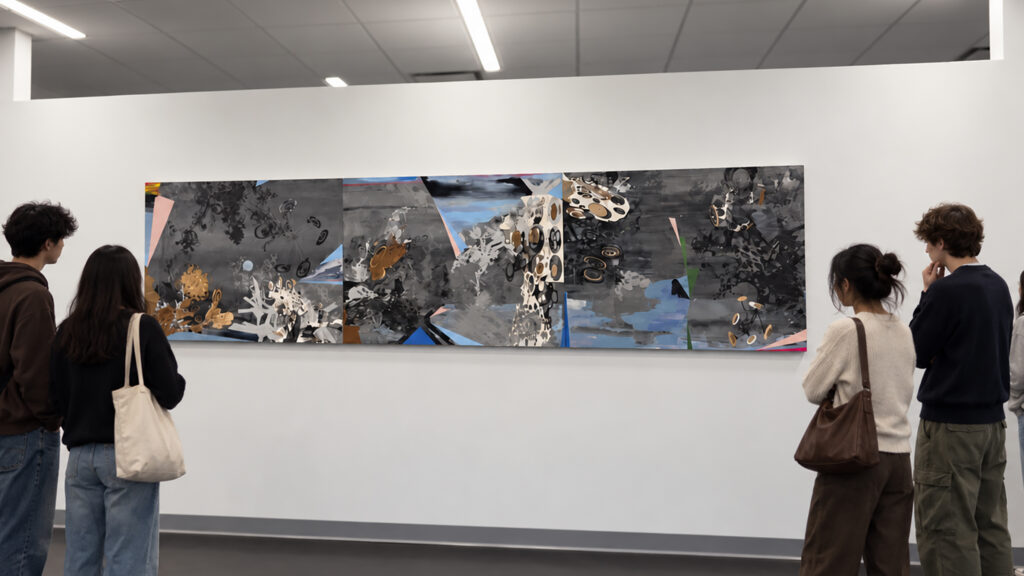
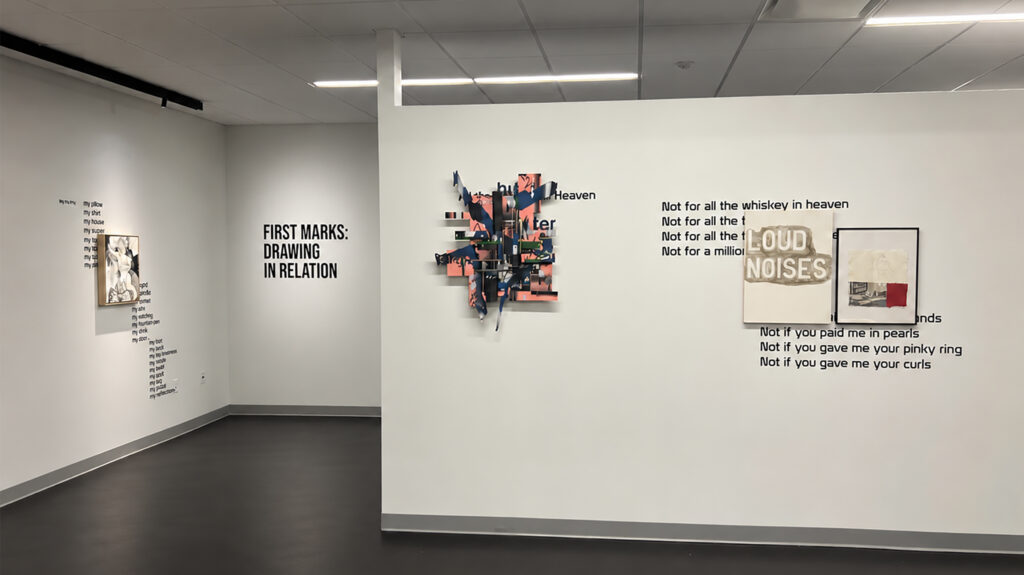
The University of Mount Saint Vincent is pleased to announce that FIRST MARKS: DRAWING IN RELATION has launched as the inaugural exhibition of the new UMSV Art Gallery. Organized by the Department of Arts and Communication, the exhibition opened on Tuesday, October 20, 2026 inside the University’s newly remodeled Student Center in the Elizabeth Seton Library.
The exhibition brings together Alexandre Arrechea, Matthew Archibald, Alejandro Contreras, Rafael Domenech, Juan Francisco Elso Padilla, Justin Favela, Baris Gokturk, Angela Kallus, Jennifer Nuss, David Teng Olsen, Lil Picard, Séverine Rebourcet, LinDa Saphan, Rirkrit Tiravanija, Alejandro Valencia, Michael Vasquez, Tomas Vu, and Thomas Ray Willis. Their practices span generations, geographies, disciplines, and artistic histories.
FIRST MARKS approaches drawing not as a fixed medium, but as a way of establishing relationships—between ideas, images, materials, histories, memories, and people. Works are intermingled throughout the gallery rather than separated by institutional affiliation, generation, or reputation, allowing meaning to shift as different practices are placed in proximity to one another.
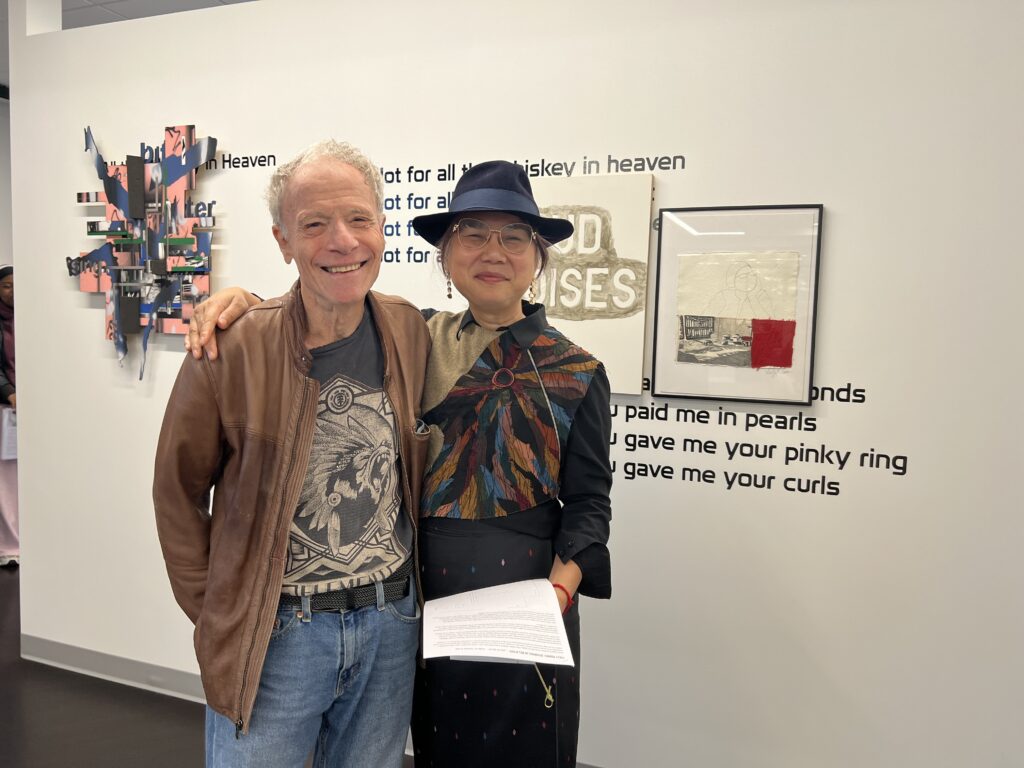
The exhibition has also received its first substantial outside critical review. In “Drawing Things Together: First Marks at Mount Saint Vincent,” published on October 25, 2026 in Whitehot Magazine of Contemporary Art, art critic and scholar Mike Maizels describes the new program as having “ambitious aims” and writes that FIRST MARKS succeeds because it recognizes that “institutions are built not only through facilities and budgets, but through relationships.” Mike also highlights the exhibition’s unexpected pairings, the participation of Mount faculty and students, and the curatorial partnership of Assistant Professor of Studio Art Thomas Ray Willis and Assistant Professor of Digital Media Rafael Domenech, considering the gallery as the beginning of a broader artistic community at the University.
Professors Domenech and Willis both contributed works that reflect their respective interests in the relationships between material, social experience, teaching, and institutional space. Professor Domenech’s “Rehearsing Splinters” brings print, collage, publication, and architecture together directly on the gallery wall, while, in “Mount Saint James,” Professor Willis shreds discarded student drawings and reconstitutes them into images from his personal life, connecting his roles as artist, professor, and parent.
They are joined by three University of Mount Saint Vincent colleagues whose practices extend the exhibition across disciplines. Assistant Dean of the School of Social Sciences and Professor of Sociology LinDa Saphan, PhD’s “Stitches” uses machine sewing learned from her mother to connect self-portraiture, inherited labor, family history, and the Cambodian landscape. Associate Professor of French Séverine Rebourcet, PhD’s drawings use food and recipes as vessels for personal and cultural memory, while Associate Professor of Sociology Matthew Archibald, PhD’s “Triptych I (Kehoe Nuit Chardin)” considers how observation and artistic practices are learned, translated, and reinterpreted across subjects and time.
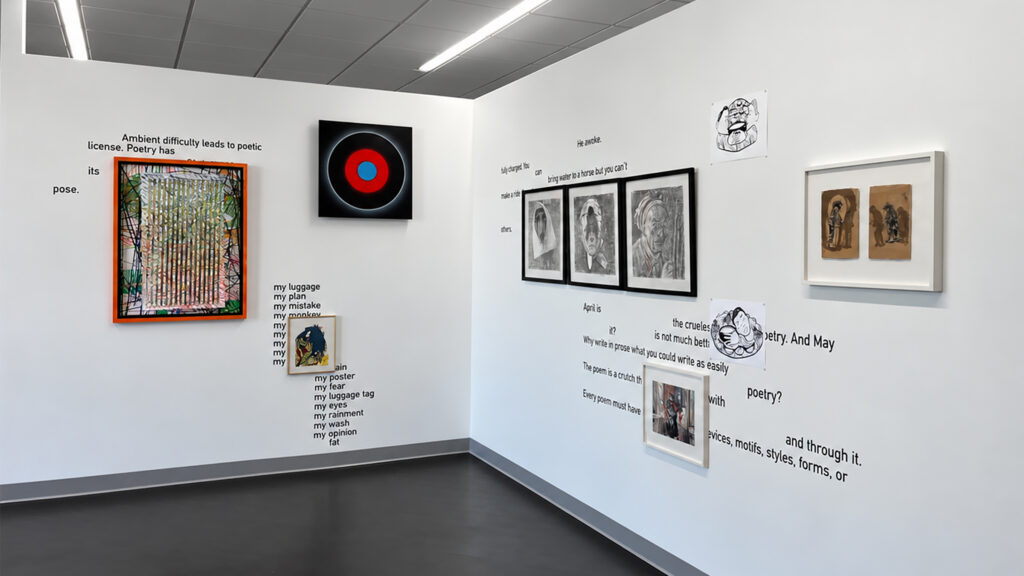
And the idea of relation extends beyond the individual artworks. Fragments from texts by poet Charles Bernstein move across the gallery walls, passing behind, alongside, and between works. Students in Professor Domenech’s COMM 346: Information Arts course helped select and install the texts in relation to the artworks. Enlarged across the walls, language becomes something to look at as well as read—operating through line, spacing, rhythm, interruption, and gesture. Student participation also makes exhibition-making itself part of the classroom.
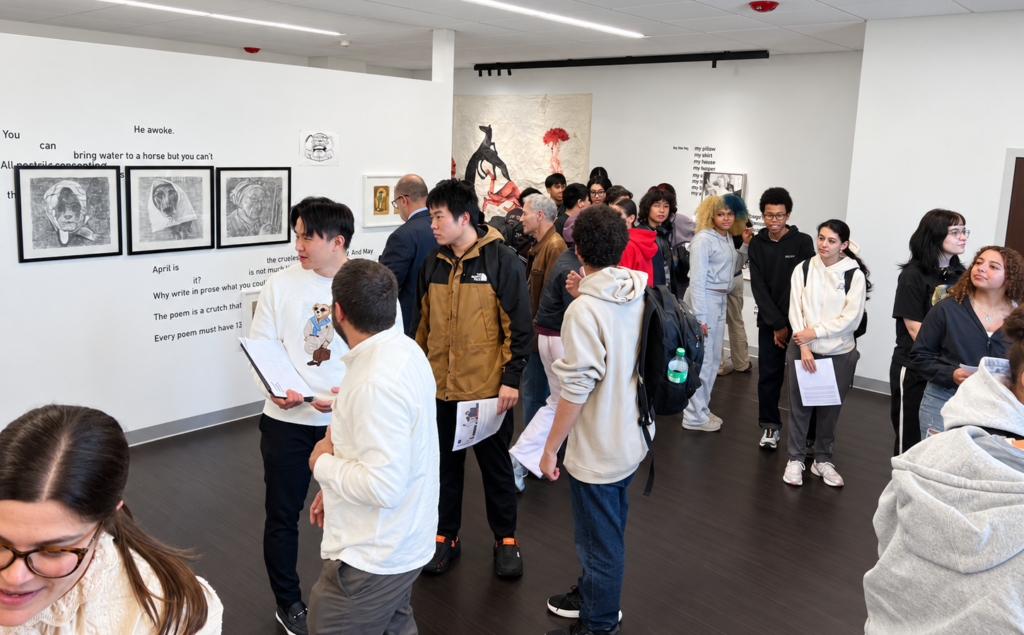
The opening of a dedicated art gallery marks an important development in the cultural and academic life of the Mount. The gallery gives students direct access to artworks, artists, and ideas while connecting creative practice to teaching, research, and disciplines across campus. It also creates a point of exchange between the University and a wider community of artists, institutions, scholars, and audiences.
As the first exhibition of the UMSV Art Gallery, FIRST MARKS establishes an ambitious foundation for future programming. Mount faculty work alongside artists with national and international practices; students participate directly in creating exhibitions; and artworks, texts, teaching, and gallery space influence one another. Rather than beginning with a single artistic style or point of view, the gallery opens as a place where different forms of knowledge, experience, and creative practice can come together.
FIRST MARKS: DRAWING IN RELATION is on view through December 10, 2026, in the UMSV Art Gallery on the second floor of the Elizabeth Seton Library and Student Center at the University of Mount Saint Vincent.
Artists and Works
Alexandre Arrechea
Untitled
Graphite on paper
Cuban artist Alexandre Arrechea works across drawing, sculpture, installation, and video, examining history, memory, politics, architecture, and systems of power. In the work included in FIRST MARKS, a hot-air balloon is paired with a gun, bringing together images of flight and threat in a deliberately unstable relationship that reflects Alexandre’s broader interest in control, conflict, and the social meanings embedded in familiar forms. A founding member of the influential Cuban collective Los Carpinteros, Alexandre has developed an internationally recognized solo practice, with work in the collection of the Museum of Modern Art and major public projects including NOLIMITS on Park Avenue in New York.
Matthew Archibald
Triptych I (Kehoe Nuit Chardin), 2024–2026
Graphite pencil on 300 lb. cold press Arches paper
Mount Associate Professor of Sociology Matthew Archibald, PhD draws on research in institutions, healthcare, and social life. In Triptych I, Dr. Archibald connects painter Catherine Kehoe, his dog Nuit, and Jean Baptiste-Siméon Chardin through the repeated motif of a head covering. Beginning with Kehoe’s self-portrait exercise using a paint rag, Dr. Archibald reinterprets the practice through photographs and a gridded drawing of Nuit, then extends the sequence to Chardin’s own headscarfed self-portrait. The work considers how artistic exercises, observation, and representation are learned, translated, and reworked across subjects and time. Special thanks to Robert Williams for mechanical images, drawing grids, and technical production.
Alejandro Contreras
Untitled
Mixed media assemblage (painted and layered paper)
Venezuelan-born Alejandro Contreras reworks the legacies of Latin American modernist abstraction through drawing, painting, sculpture, and installation. Shaped by the visual languages of Jesús Rafael Soto, Carlos Cruz-Diez, Alejandro Otero, and Gego, his materially improvisational practice explores the tension between chance and structure, object and space. A graduate of Columbia University’s MFA program, Alejandro has exhibited at the Frost Art Museum, Southeastern Center for Contemporary Art, and internationally, with residencies including Oolite Arts at Anderson Ranch and Tropical Lab in Singapore.
Rafael Domenech
Rehearsing Splinters, 2026
Inkjet print on various papers, paint, laser print on paper, wood, and archival adhesive
Cuban-American artist and Mount Assistant Professor of Digital Media Rafael Domenech works across architecture, publishing, installation, print, and social exchange, treating exhibitions as active structures for gathering and production. In Rehearsing Splinters, Professor Domenech assembles printed fragments, images, graphic elements, and materials directly onto the gallery surface, creating a provisional field where drawing, publication, and architecture overlap. His work has appeared in the 58th Carnegie International and at institutions including SculptureCenter, the MIT List Visual Arts Center, and the Bronx Museum of the Arts.
Juan Francisco Elso Padilla
Untitled
Mixed Media
Juan Francisco Elso Padilla was a central figure in the first generation of artists educated in post-revolutionary Cuba to gain international recognition in the early 1980s. Working primarily with natural and organic materials, Juan brought Indigenous traditions, Afro-Caribbean spiritual practices, and the histories of colonialism into a sculptural language that expanded prevailing ideas of Cuban and Latin American identity. His work anticipated many of the postcolonial and decolonial concerns that have since become central to contemporary art discourse. His continuing influence was examined in the major traveling retrospective Juan Francisco Elso: Por América, organized by El Museo del Barrio and presented alongside a multigenerational group of artists from across the Americas.
Justin Favela
The Valley of Mexico from the Hill of Santa Isabel, 2016
Cut tissue paper and adhesive on support (mixed media)
Guatemalan-Mexican-American artist Justin Favela has become an important voice in contemporary Latinx art by transforming piñata-making and other vernacular forms into a language for sculpture, installation, and painting. In The Valley of Mexico from the Hill of Santa Isabel, Justin uses cut tissue paper and adhesive to reinterpret a canonical Mexican landscape through the materials and techniques of piñata craft, bringing questions of cultural identity, art history, and representation into direct relation. A 2021 Joan Mitchell Fellow, Justin has exhibited at major institutions including the Smithsonian American Art Museum’s Renwick Gallery, MASS MoCA, El Museo del Barrio, the Denver Art Museum, Pérez Art Museum Miami, and the Amon Carter Museum of American Art, and has presented projects with Crystal Bridges Museum of American Art.
Baris Gokturk
Untitled
Mixed media
Turkish artist and educator Baris Gokturk works across painting, drawing, sculpture, and installation, transforming archival images and fragmented figures to explore regeneration, political unrest, and the possibility of change. An Associate Professor at Rhode Island School of Design, Baris has been a NXTHVN and ApexArt Fellow and participated in residencies including Yaddo, ISCP, and Skowhegan. His work has been exhibited at the New Museum, the Jewish Museum, the Frost Art Museum, and Pera Museum, with public commissions for the Public Art Fund and Columbia University.
Angela Kallus
Acrylic and airbrush on canvas over panel
Angela Kallus emerged from the influential UNLV circle around critic Dave Hickey, whose renewed arguments for beauty and visual pleasure became an important part of contemporary art discourse. Angela moved to Las Vegas specifically to study with Hickey and was later included in Las Vegas Diaspora, his exhibition tracing the artists shaped by that milieu, which traveled from the Las Vegas Art Museum to the Laguna Art Museum. Her meticulous paintings and drawings foreground craft, repetition, surface, and beauty, extending these questions through sustained looking and skilled making. She was a 2016 artist-in-residence at LUX Art Institute, and her work is held in public collections including the Marjorie Barrick Museum of Art and the City of Las Vegas.
Jennifer Nuss
Untitled, 2000
Gouache and collage on paper
Jennifer Nuss has developed a distinctive figurative practice across drawing, painting, printmaking, and animation, bringing beauty and the grotesque into uneasy relation through images of bodily transformation, fantasy, and myth. Her work expands the expressive and psychological possibilities of contemporary drawing while moving fluidly between traditional and time-based media. Jennifer received a John Simon Guggenheim Memorial Fellowship, a Joan Mitchell Foundation Award, and a New York Foundation for the Arts fellowship in drawing, as well as a residency from the Marie Walsh Sharpe Art Foundation.
David Teng Olsen
Jungle Redux
Lithograph
David Teng Olsen has developed an interdisciplinary practice that bridges traditional image-making and new media, bringing printmaking and mural painting into dialogue with animation, interactive technology, performance, and public art. Drawing on an early background in bioengineering and scientific illustration, his work examines how identity and culture are shaped by technology, often through collaborative and site-specific projects. He is Professor of Art, Director of Studio Art, and Co-Director of Media Arts and Sciences at Wellesley College, and has created large-scale public works nationally since 1999.
Lil Picard
Portrait of Rob, 1976
Marker on paper napkin
Lil Picard was an important figure in New York’s postwar counterculture whose practice helped expand the emerging languages of happenings, performance, assemblage, and environmental art. Her politically engaged performances addressed war, gender, and social oppression, while her work as an art critic and longtime New York correspondent for the German newspaper Die Welt helped shape European understanding of American art, particularly during the emergence of Pop Art. Her 1967 performance Construction–Destruction–Construction was filmed by Andy Warhol, and her work appeared in landmark exhibitions and Avant Garde Festivals throughout the 1960s and 1970s.
Séverine Rebourcet
Lamb for Love, 2026 (top)
Fish Broth for Memories, 2026 (bottom)
Chinese ink, marker, and pen
Mount Associate Professor of French Séverine Rebourcet, PhD pairs drawing with scholarship on Francophone literature, migration, and identity. Her works in FIRST MARKS began as illustrations for an African recipe book in which food becomes a way of carrying memory and personal history. One image centers on a fish broth associated with the author’s father, while another uses gigot d’agneau as a symbol of love, sharing, and intimacy. Dr. Rebourcet incorporates ingredients, figures, and patterns inspired by African wax fabrics into bowl-like compositions, allowing the drawings to hold both the practical elements of a recipe and the emotional meanings attached to it.
LinDa Saphan
Stitches
Mixed media on Khadi paper
Cambodian artist, social anthropologist, and Mount Assistant Dean of the School of Social Sciences and Professor of Sociology LinDa Saphan, PhD works across drawing, painting, photography, sculpture, and installation, engaging memory, gender, diaspora, and contemporary Cambodian experience. In the work included in FIRST MARKS, Dr. Saphan returns to the sewing she learned while helping her mother, a seamstress who supported their family. Rendering a self-portrait entirely in machine stitches, she connects inherited labor and care with images drawn from the Cambodian landscape, using fabric and thread as both material and metaphor for an identity shaped by family, homeland, memory, and survival. Dr. Saphan has also played an important role in Cambodia’s contemporary art scene, co-organizing the landmark 2005 Visual Arts Open in Phnom Penh and founding Selapak Neari, which created workshops, networks, and exhibition opportunities for emerging women artists. A 2024 Fulbright Scholar, her work has been exhibited across Southeast Asia, Europe, and North America.
Rirkrit Tiravanija
Loud Noises
Ink and graphite on panel
Rirkrit Tiravanija is one of the artists most closely associated with the emergence of relational aesthetics in the 1990s, shifting attention from the autonomous art object toward participation, hospitality, and social exchange. His ongoing Demonstration Drawings, begun in 2006, extend these concerns into drawing: Rirkrit commissions Thai artists and students to translate press photographs of protests and mass demonstrations into graphite works, transforming fleeting images of collective action into lasting records of political aspiration. His honors include the 2004 Hugo Boss Prize, and his four-decade survey A LOT OF PEOPLE was presented at MoMA PS1.
Alejandro Valencia
Bulls on Parade
Mixed media
Alejandro Valencia uses drawing, found materials, language, and assemblage to treat history as something that can be dismantled and reconfigured, examining how migration, dissent, memory, and power shape collective identity. Informed by research in Memory Studies and Political Aesthetics, his practice uses cultural and material hybridity as a method for keeping historical meanings unstable and open to revision. A Columbia University MFA graduate, Alejandro has received a LeRoy Neiman Foundation Fellowship and Miami Individual Artist Grant and has been recognized by the Sara Modiano Foundation and Harpo Foundation; his work has been exhibited in the United States, Colombia, Honduras, and France.
Michael Vasquez
Untitled
Mixed media
Michael Vasquez has developed a distinctive approach to contemporary portraiture centered on identity, masculinity, belonging, and community within marginalized neighborhoods. His large-scale paintings use portraiture to examine how identity is shaped through social bonds, environment, dress, symbols, and public perception. Michael was one of six Latino artists featured in the Smithsonian National Portrait Gallery’s Portraiture Now: Staging the Self, which explored the construction and negotiation of identity, and was later selected as a finalist for the museum’s 2019 Outwin Boochever Portrait Competition. His work has also been exhibited at institutions including the Saatchi Gallery, Frost Art Museum, MOCA North Miami, and Kemper Museum of Contemporary Art.
Tomas Vu
Dark Side of the Moon
Silkscreen, acrylic, inkjet photographs, Plexiglas, and collage on panel
Tomas Vu has been a significant figure in contemporary printmaking and its expansion into installation, collaborative practice, and the broader field of contemporary art. Since helping found Columbia University’s LeRoy Neiman Center for Print Studies in 1996, where he serves as Professor of Visual Arts and Artistic Director, he has helped position printmaking as a space for experimentation and interdisciplinary exchange. In Dark Side of the Moon, Tomas constructs a futuristic, post-industrial landscape that reflects on technology, the boundary between human and machine, and the environmental and social consequences of technological progress. The series also uses the unseen side of the moon as a metaphor for the unknown, pairing mystery with ideas of distance, absence, and transformation. A Guggenheim, Joan Mitchell Foundation, and Louis Comfort Tiffany Foundation award recipient, Tomas has exhibited internationally at institutions including MoMA PS1 and the National Art Museum of China.
Thomas Ray Willis
Mount Saint James, 2026
Collage of discarded student drawings (graphite, charcoal, and ink on paper)
Artist and Mount Assistant Professor of Studio Art Thomas Ray Willis transforms unconventional materials and processes into works concerned with memory, personal history, and social connection. Within the exhibition, Professor Willis shreds discarded student drawings and reconstitutes them into an image from his personal life, connecting his roles as artist, professor, and parent. The fragments retain traces of observation, revision, labor, and learning, while their original images and authorship begin to disappear. By transforming drawings once treated as exercises or discarded attempts, Professor Willis considers how value shifts through acts of making, judgment, preservation, and reuse. His work and publications are represented in collections and archives including the MoMA Archives, Whitney Museum Library, New York Public Library, and Printed Matter, and his projects have included work with the Art Production Fund and the Hudson River Museum.
About the University of Mount Saint Vincent
Founded in 1847 by the Sisters of Charity, the University of Mount Saint Vincent offers a nationally recognized liberal arts education and a select array of professional fields of study on a landmark campus overlooking the Hudson River. Committed to the education of the whole person, and enriched by the unparalleled cultural, educational, and career opportunities of New York City, the University equips students with the knowledge, skills, and experiences necessary for lives of achievement, professional accomplishment, and leadership in the 21st century.